Account compromise on social media
On Tuesday morning I woke up to a notification from Filip Horký about an attack on our soldiers... a few moments later the message was denied — the Prime Minister's account had been hacked. Not just his — the Spolu coalition account as well. How the vxunderground account, which was tagged in that post, is connected we don't know. The same fate also befell the account of the Parliament of South Africa.!
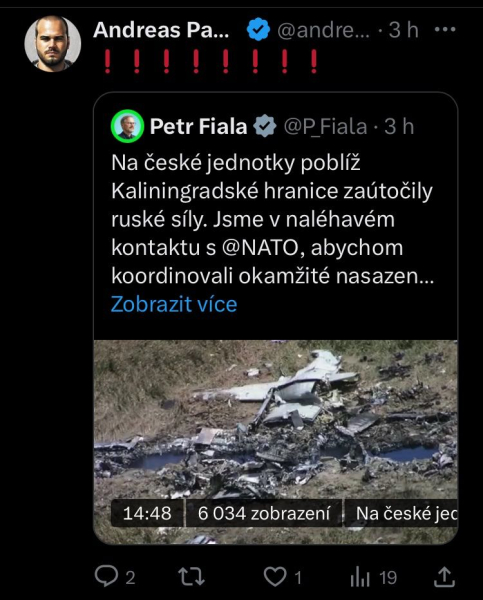 Post reshared by Czech Television's correspondent in Poland
 Filip Horký's update
 The identical message on the Spolu coalition profile
 Another message on the Spolu coalition profile tagging @vxunderground
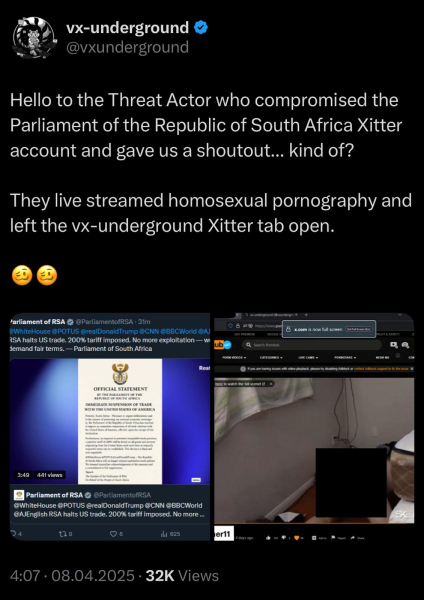 The @vxunderground profile commenting on being tagged by the Parliament of South Africa's account
At first glance you'd say they were missing 2FA and someone guessed the password. For shared accounts that's a common weakness and nothing unusual. However, during the day the Government Office issued a statement explicitly mentioning two-factor authentication. With that in mind, only two hypotheses remain.
- Access via a third-party application used to manage social media
- An infostealer
Third-party application
If you manage multiple social networks, this is nothing unusual. You can have several accounts linked to your own account. Once a compromise occurs, all of them are exposed to danger. Such an account and the access it provides must be protected accordingly — ideally with Passkeys login.
Infostealer
Nowadays it's nothing unusual to end up with something like this on your computer. Whether via phishing or some other route. The result is always the same — you lose your data, specifically passwords, payment cards... basically everything an attacker can extract = sell.
Whatever the attack vector was… the result is the same. A loss of trust. Pay attention to securing your accounts and use the best protection available. A second factor is a good foundation. Passkeys are ideal. The same level of security applies to all platforms or applications you use for access — apps on your phone (biometrics to unlock), third-party applications, and the email address you used to register with the service.
