How to Trace Your Ancestors in Parish Registers with GPT
Searching parish registers is a peculiar discipline. At first you think all it takes is finding the right book, flipping to the right year and reading a name. Then you open your first 19th-century Protestant register and discover you can't even tell where one word ends and the next begins.
This is where GPT can help a lot. Not as a magic genealogist who builds the correct family tree from a single query, but as a research partner: it helps find the right books, read old entries, compare data and, above all, make sure we don't mix up the wrong people.
After several hours of searching together, a few principles proved their worth.
1. A Family Tree Isn't Proof. It's a List of Leads.
When you already have a family tree from MyHeritage, Ancestry or from relatives, it's very tempting to treat it as the starting truth.
But that's one of the fastest roads to a mistake.
It's better to think of an old family tree like this:
"Someone before me believed this person belongs here."
Nothing more.
A name, a date, a house number or a surname from a family tree can be a very useful lead. But GPT shouldn't be given the task:
Find proof that this person was the son of that person.
A much better request is:
Independently find out who this person's parents were, and only then compare the result with the existing family tree.
That's a crucial difference.
Otherwise it's very easy for the model to "see" exactly the surname you hinted at in advance in an illegible handwriting.
2. Go From Certain to Uncertain
Genealogy is a bit like a detective story.
It's best to start with a person we have solidly documented and always move back just one generation at a time.
For example:
child's birth → parents → parents' wedding → their births → their parents
Not:
I know the surname → I find someone with the same surname 80 years earlier → surely that's an ancestor.
GPT is very good at finding connections. And that's exactly why it needs to be held back a little.
Similarity isn't proof.
3. One Record Isn't Enough
The most important principle of our search turned out to be very simple: cross-referencing.
We try to find the same person in several independent records.
Typically:
- birth,
- marriage,
- birth of a child,
- death,
- possibly births of siblings.
When several records repeat:
- the same name,
- the same parents,
- the same house number,
- a similar age,
- the same occupation,
the identification starts to become very strong.
On the other hand, if one record says something different, it's not a good idea to "bend" it to fit the family tree.
A contradiction is information.
4. House Numbers Are Genealogical Gold
In small villages the same surnames repeat often.
You can have several families with the same surname, several men with the same first name and sometimes several people born around the same time.
A house number can therefore be a fantastic identifier.
Of course, it doesn't mean the family lived in one place all their lives. But when the same house number repeats across several records, it's a very strong lead.
When working with GPT, it pays off to ask for:
For each person, record the name, date, house number, parents and source.
Not just the name and date.
5. GPT Should Be a Paleography Helper, Not a Fortune Teller
Old registers can be written in Kurrent, German, Latin or a combination of several languages.
GPT can often read a surprising amount.
But not always.
And the biggest danger isn't that it says "I don't know". The biggest danger is that it reads illegible text very confidently and wrongly.
That's why we found it useful to split readings into three levels:
Certain reading
The text is clearly legible.
Probable reading
The letters match, but it's not a hundred percent.
Hypothesis
A certain surname could be there, but we need another record.
This is what a two-page spread of a baptism register from 1882 looks like. Anyone can read the printed columns, but with the handwritten entries the reading quickly slides from certain to hypothesis:
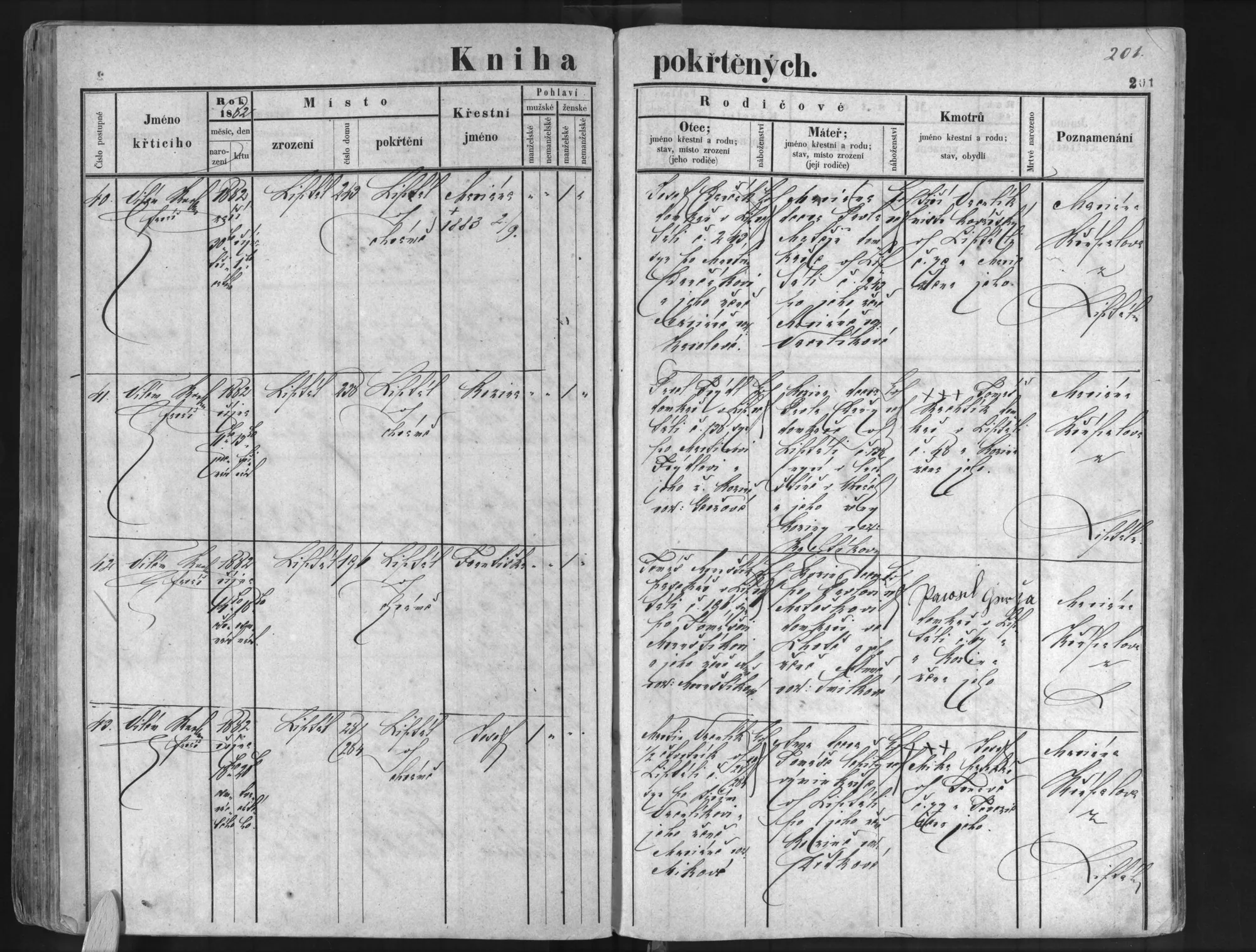
In my opinion, this distinction is absolutely essential in genealogy with AI.
6. Don't Give the Model Too Many Hints
An example of a bad request:
The mother should be Nováková here. Does it say Nováková?
At that moment the model has a very strong tendency to look for exactly that form.
Better:
Read the mother's surname independently. Ignore the previous family tree.
And only then:
Compare your reading with the hypothesis Nováková.
It's basically a small "blind test".
7. When One Entry Is Illegible, Go Around It
This was one of the most practical findings.
Sometimes you can sit over a single word for twenty minutes and still have no idea what it says.
You don't necessarily have to decipher it.
If, for example, we can't read the groom's parents in a marriage entry, we can look for:
- his birth,
- the birth of his sibling,
- the birth of his child,
- his death,
- another marriage in the family.
A different scribe may write the same name far more legibly.
Genealogical research is therefore not a contest in reading one old word. It's assembling evidence from multiple documents.
8. GPT Is Great at Steering the Research
Perhaps the biggest contribution isn't reading the register itself.
It's the ability to hold the structure of the search.
For example:
We have confirmed A and B.
We don't know C.
The candidates are D and E.
The next document that could decide it is the marriage of X.
When you're going through registers for hours, this is invaluable.
That's why it's good to keep something like an evidence table as you go:
| Person | Event | Date | House no. | Parents | Source | Status |
|---|---|---|---|---|---|---|
| person A | birth | … | … | … | register… | confirmed |
| person B | marriage | … | … | … | register… | confirmed |
| person C | birth | … | … | … | register… | candidate |
GPT can keep this table up to date for you.
9. Keep the Exact Source
After a few hours of searching, this moment comes very quickly:
Where did we actually find this date?
That's why for every finding we save:
- the name of the register,
- the signature / inventory number,
- the image number,
- the entry number,
- possibly the handwritten page number,
- a direct link.
Without that, even a correctly found piece of information can become practically unusable within days. From a forensic point of view it's the same as with evidence: what has no traceable origin can't be verified.
An ideal note therefore doesn't look like this:
Jan – born 1877.
But like this:
Jan – birth 1877, Protestant register XY, inv. no. 1234, image 110, entry no. 8.
That's the difference between a family note and genealogical research.
10. AI Can Make a Mistake. And Sometimes Only Another Document Corrects It.
During the search it happened several times that the first reading looked very convincing.
Then we found another record and discovered that:
- the month was different,
- the house number was different,
- the surname had been misread,
- or we had even been following a different person of the same name.
That's not a reason to avoid AI in genealogy.
It's a reason to use it as critically as a human researcher.
The right approach isn't:
GPT read it, so it's true.
But:
GPT proposed a reading. Now we'll verify it against another source.
11. What I'd Ask GPT at the Start Today
If I were starting over, my first prompt would look something like this:
Help me with genealogical research in parish registers. Work only from primary records. Use the existing family tree only as a list of hypotheses.
For each finding, distinguish:
- a confirmed fact,
- a probable reading,
- a hypothesis.
Try to verify each person with at least two independent records. Track names, dates, house numbers, parents, occupation and place.
If the text is illegible, don't fill it in based on expectation. Suggest another document that can verify the detail.
For every result, save the exact register, signature, image number and entry number.
That doesn't turn GPT into the author of the family tree.
It becomes a research assistant.
And in my opinion that's exactly the role in which it's strongest when searching historical registers.
The biggest surprise for me in the end wasn't how well AI can read old handwriting.
It was how well it can hold the logic of the search: reminding me what is already documented, what is only a suspicion and which document can decide between two possibilities.
That's why I wouldn't describe genealogy with GPT as "letting AI find your ancestors".
Rather as: having a very fast research assistant next to you. You just have to keep checking its homework.